
What should a field expense report contain?
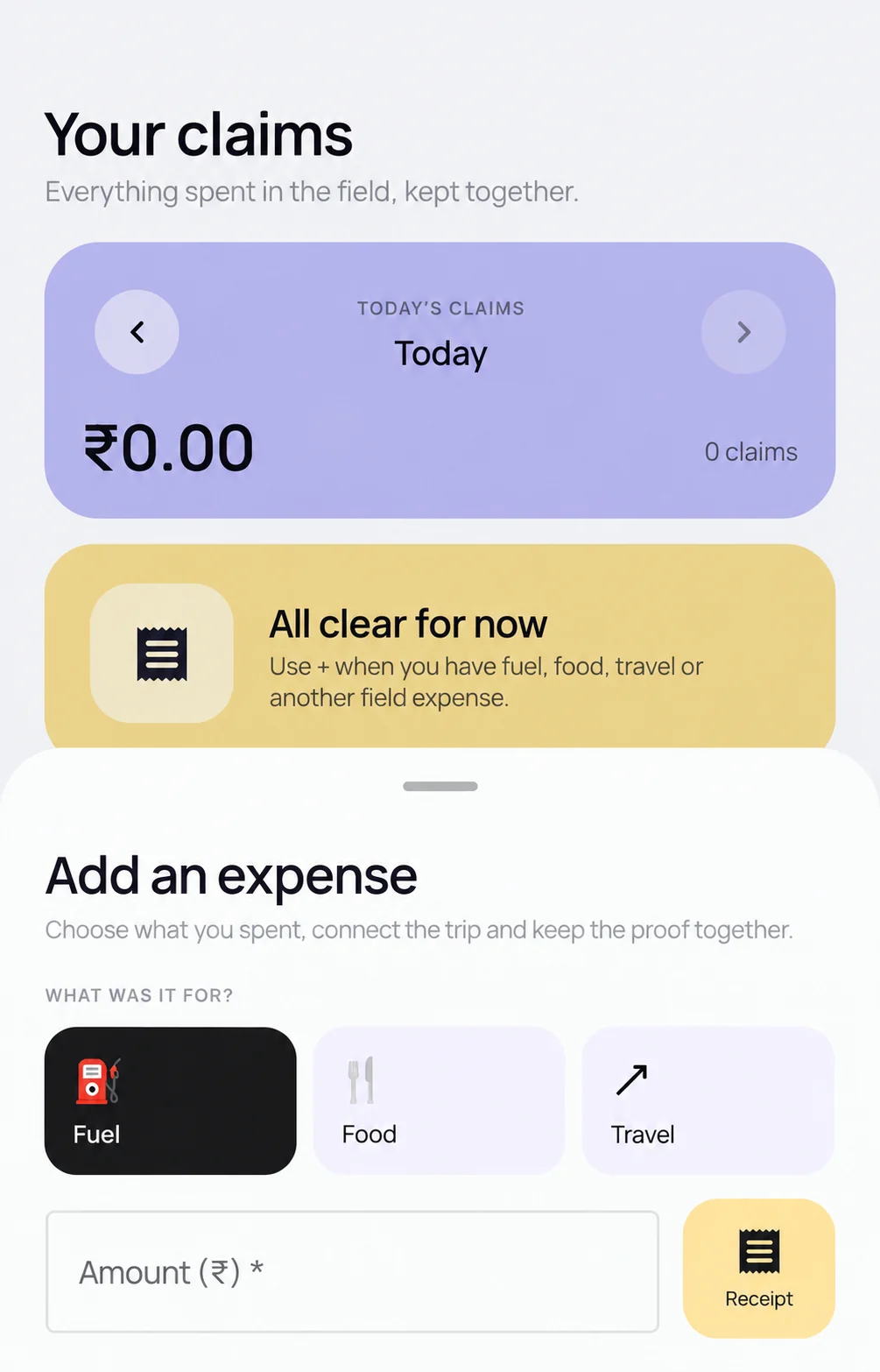
A field expense report should connect employee identity, business dates, customer or trip purpose, expense lines, supporting receipts, eligible distance, advances, and the review decision. Use the calculator below for a local, editable example; it is not a submitted Scootee claim or a tax calculation.
Report header
Include employee ID and name, department or branch, reporting period, trip or customer reference, business purpose, currency, and policy version. Keep the same employee identifier in your attendance and finance handoff so names do not become the only way to match records.
Expense lines
| Field | Why it matters |
|---|---|
| Expense date and category | Establishes the period and policy treatment |
| Amount and currency | Prevents mixing currencies or assuming an exchange rate |
| Customer, visit, trip, or session reference | Connects the cost to the work |
| Receipt or explanation | Gives the reviewer supporting evidence |
| Claimed and approved values | Preserves the difference between submission and decision |
| Reviewer, status, and reason | Makes returns and corrections traceable |
Reconcile a business advance
Record the advance actually received, not merely requested or approved. Subtract it from the approved report total. A positive balance is due to the employee; a negative balance is money to reconcile or return under company policy. Record settlement separately from approval. The calculator below demonstrates the arithmetic without storing your inputs on a server.
Avoid counting fuel and mileage twice
Some company policies use a mileage allowance intended to cover vehicle costs; others reimburse specific expenses. Confirm which approach applies before adding fuel and a mileage allowance for the same journey. Parking and tolls also need their own policy treatment.
When does a spreadsheet stop being enough?
A template is useful for a small team or a policy pilot. A connected system becomes more useful when reviewers repeatedly chase receipts, cannot match visits to expenses, lose returned-claim history, or cannot reconcile advances by employee and trip.
Scootee connects employee expense management, customer visit tracking, and mileage reimbursement review. Bring one real report to a walkthrough and check the employee action, approval, return path, and finance handoff.
Is this a statutory form or a compliance guarantee?
No. This is an operational report structure and illustrative calculation. Your company decides its policy with qualified advice where needed. Tax substantiation and country-specific reimbursement requirements must be evaluated separately.