
Kilometres are written from memory
Staff fill a monthly sheet with rounded numbers, and accounts has no way to check whether 80 km on the 12th was real.
Conveyance reimbursement
Turn each recorded work session into a conveyance claim at the employee’s per-km rate, attach fuel, toll and food bills, and send it to accounts for approval.
Overview
Conveyance reimbursement pays employees back for business travel, usually at a fixed rate per kilometre for a two-wheeler or car. In Scootee, the distance comes from the employee’s recorded work session, so the claim starts from the kilometres actually travelled instead of a number typed from memory. The company sets per-km rates for each employee’s bike or car. Employees add fuel, toll, parking and food bills as separate claims. Accounts reviews the trip and receipts before approving, and exports the result in INR.
From recorded trip to INR claim
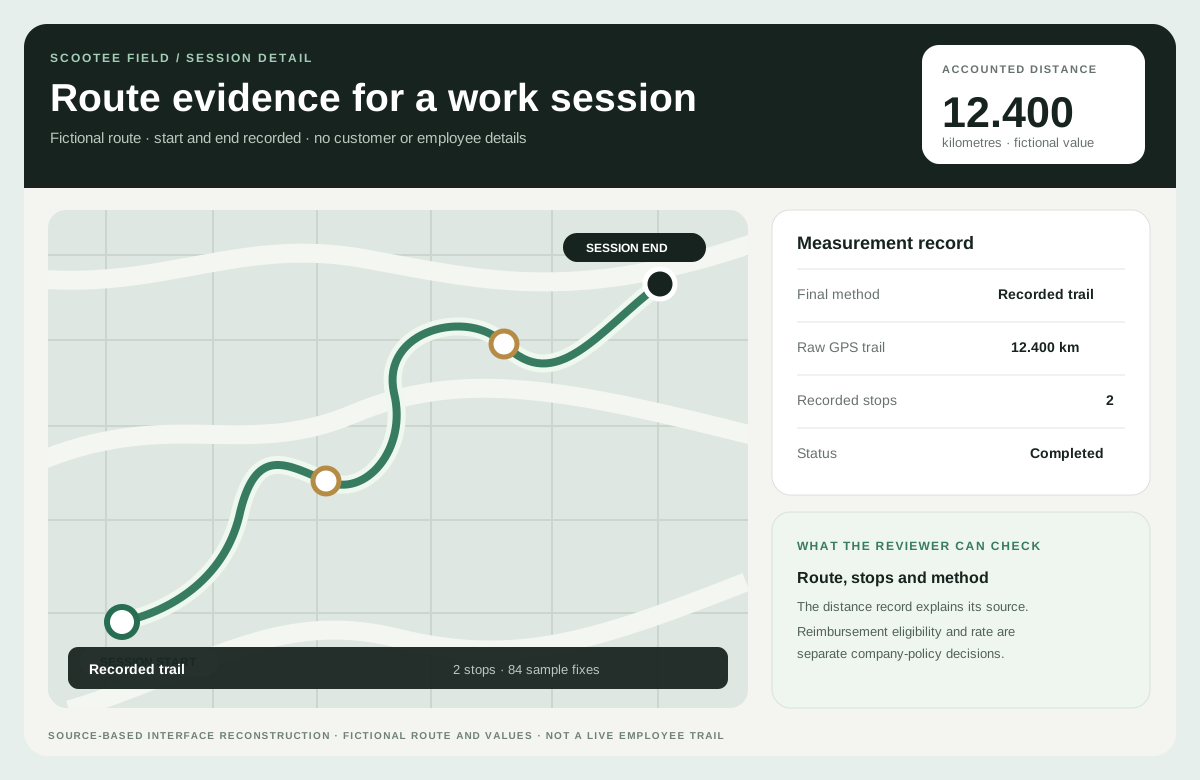
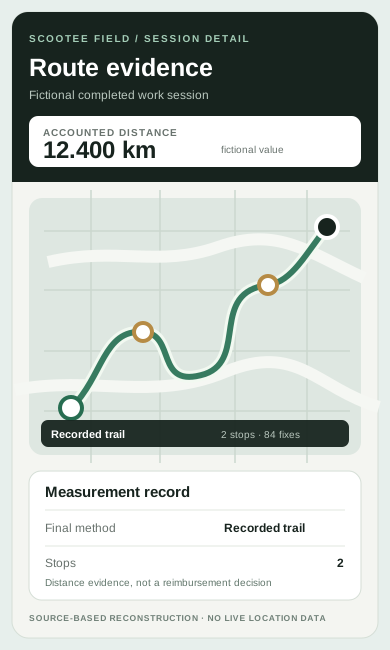
The session record shows the route, stops and final distance with its method. The employee adds bills such as fuel, toll or parking in INR with a receipt photo. Accounts reviews both before approving.
Use the finalised session km and its calculation method, not a typed monthly total.
Apply the per-km rate set for the employee’s two-wheeler or car.
Approve or return with a reason; payment runs through payroll or banking.
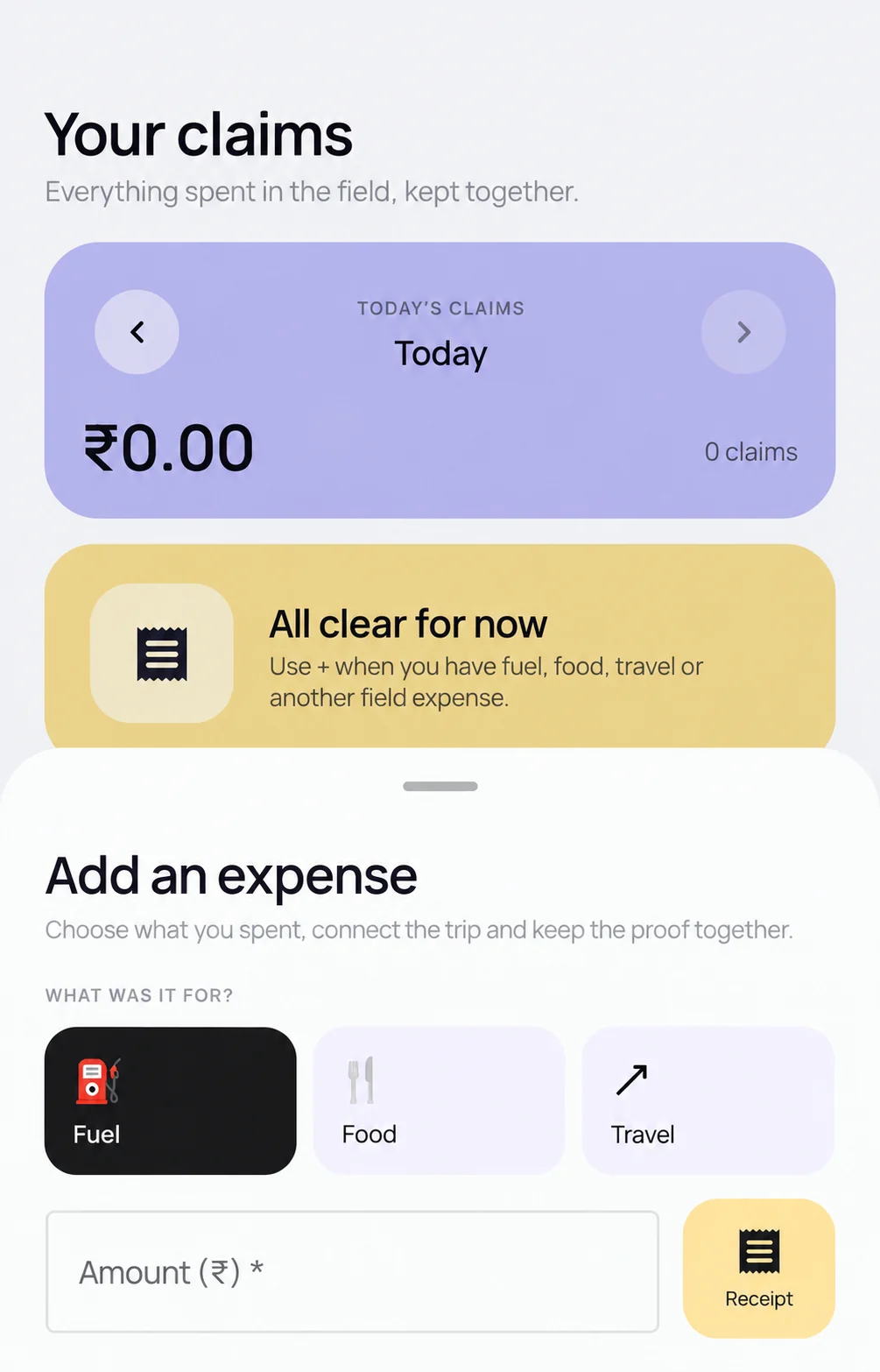
The route review is a fictional source-based reconstruction. The Android expense entry is privacy edited and shows an INR amount.
The operational friction
Staff fill a monthly sheet with rounded numbers, and accounts has no way to check whether 80 km on the 12th was real.
Fuel, toll and lodging bills come over WhatsApp or as a pile of paper at month end, separate from the trip they belong to.
Managers and accounts ask the same questions every month, and employees wait for their money without knowing what is pending.
How it works
Follow the employee action, the available supporting records and the review decision. Confirm your configuration in a demo.
Record each employee’s two-wheeler and car per-km rates, and decide which trips are eligible and what is excluded, such as home-to-office travel.
The employee starts a work session in the field app. The app records the route and finalises the distance in kilometres with its method shown.
Conveyance is calculated from the recorded distance and the employee’s rate. Fuel, toll, parking and meal bills are added as separate claims with photos.
An authorised reviewer checks the route, visits, distance and receipts, then approves or returns the claim with a reason the employee can see.
Approved conveyance is exported with kilometres, per-km rate and INR amount for payroll or payment. Payment itself happens in your payroll or banking process.
Product capability index
Store separate two-wheeler and car rates per employee instead of one company-wide number in a spreadsheet.
Use the finalised session distance, with its calculation method and quality, as the starting point of the claim.
Employees record fuel, toll, parking, food and other business costs under your categories with a receipt photo.
Reviewers approve or send back a claim with a reason, so the history of each decision is kept.
Open the route, stops and customer visits behind a conveyance claim before deciding.
Export approved conveyance with kilometres, rate and amount for the monthly payroll or reimbursement run.
Pilot success measures
Questions for your evaluation
Questions / answers
Conveyance reimbursement is the money a company pays back to an employee for official travel, such as visiting customers or sites. It is usually calculated at a fixed rate per kilometre for the employee’s two-wheeler or car, sometimes with actual bills for public transport, tolls or parking.
Scootee takes the distance from the employee’s recorded work session and multiplies it by the per-km rate set for that employee’s vehicle. Other costs such as tolls, parking and meals are separate claims with receipts. Your policy decides which trips are eligible.
An allowance is usually a fixed monthly amount paid regardless of actual travel. A reimbursement pays back documented official travel. Tax treatment depends on your salary structure and current income-tax rules, so confirm it with your tax adviser.
Yes. Employees record expenses with a category, amount, purpose and receipt photo in the field app. On Android, a claim can be saved on the phone before it uploads.
No. Scootee prepares, reviews and exports approved claims. Payment happens through your payroll or bank process.
Bring one real workflow
Bring one example of your current process. Check employee capture, office review, exceptions and the handoff your team needs.