
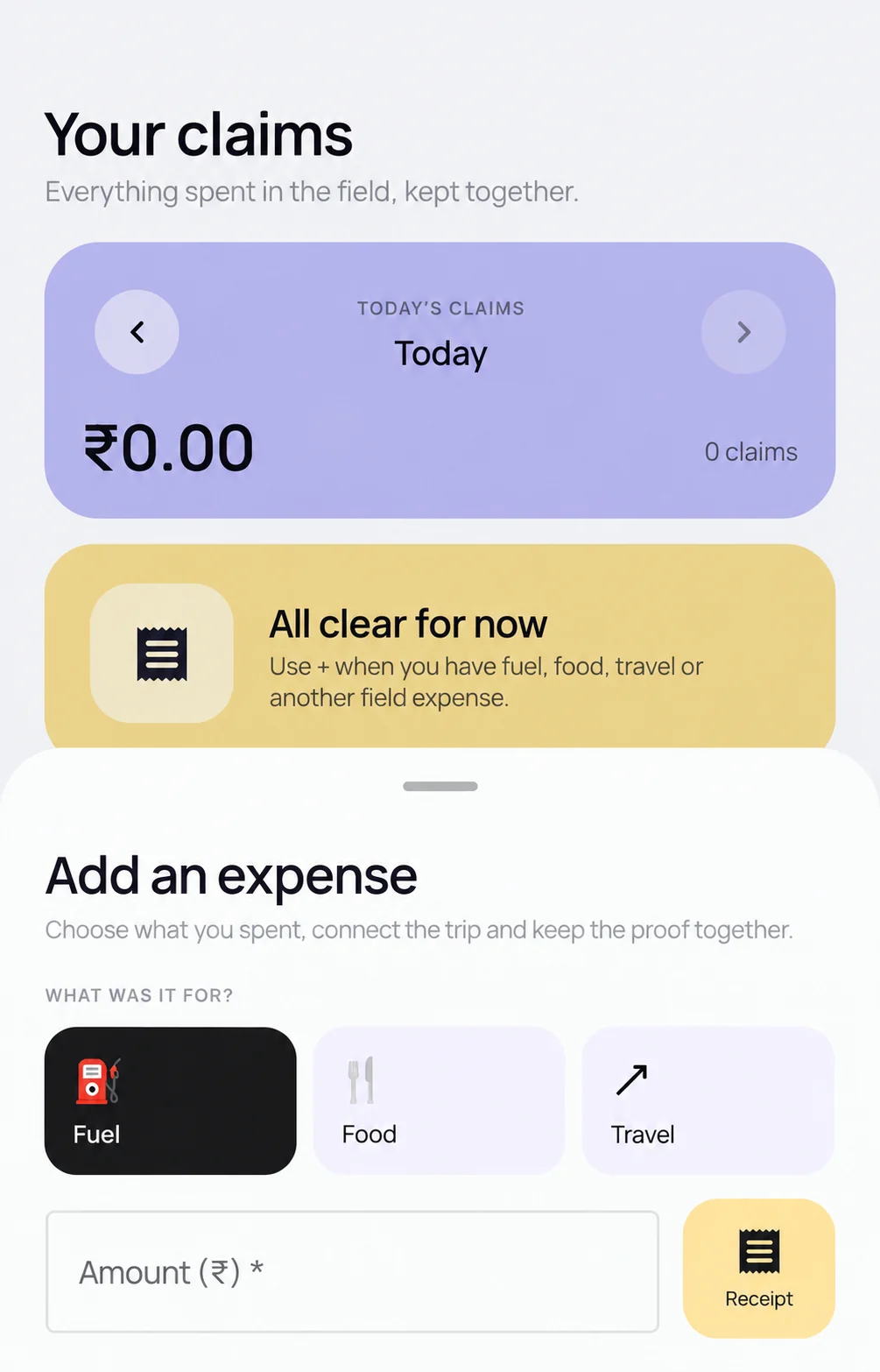
What is the employee expense reimbursement process?
The employee expense reimbursement process takes a business cost from the employee’s receipt to an authorized decision and finance settlement. The employee records the cost, submits an expense report, and answers any review questions. The reviewer approves eligible costs or returns incomplete claims. Finance reconciles advances and records the actual payment separately.
For field teams, the useful context can include the customer visit, business trip, work session, or task behind the cost. That context helps explain an expense; it does not replace the receipt, company policy, or reviewer’s decision.
Who owns each step?
| Owner | What they do | What the next person needs |
|---|---|---|
| Employee | Records business costs, attaches receipts, and submits the report | Complete expense lines and a clear business purpose |
| Assigned manager, where required | Reviews the business purpose or trip request | A recorded decision and any approved amount |
| Authorized expense reviewer or accounts team | Checks supporting evidence and decides which costs are eligible | Approved amounts, returned items, and specific reasons |
| Finance or payment owner | Reconciles money already released and completes settlement through the company’s finance process | An approved record, advance history, and payment reference |
Confirm the route for each type of request. An ordinary expense claim and a business-trip advance can have different reviewers. A manager’s trip approval should not be mistaken for an accounts decision or a completed payment.
1. Capture the expense while the details are available
Record the date, amount, currency, category, merchant, and business purpose. Attach the receipt or required supporting document. For a customer visit, include the relevant customer or trip reference so the office team can connect the cost to the work.
A note such as “parking for the afternoon customer installation” is more useful than “travel.” Keep separate costs on separate lines when the categories, receipts, or policy treatment differ.
Check that the receipt is readable and its upload completed. A photo selected on the phone is not necessarily a document received by the office. When connectivity interrupts submission, the employee needs to know whether the record is still queued or ready for review.
2. Bring the relevant entries into an expense report
Use a defined reporting period or business trip. Check for missing dates, repeated entries, unrelated personal costs, and mixed currencies before submitting. Keep the employee identifier and business reference consistent throughout the report and finance handoff.
Separate these amounts:
- Claimed amount: what the employee submits.
- Approved expense amount: the portion accepted after review.
- Advance received: money actually released before settlement.
- Settlement amount: the remaining reimbursement or return after reconciliation.
The field expense report template gives a practical structure for the header, individual costs, evidence, and reviewer fields.
3. Review the evidence and record a clear decision
The reviewer checks the business purpose, expense category, amount, receipt, applicable company policy, and available trip or visit context. An eligible cost can then be approved. An incomplete claim needs a specific return reason so the employee knows what to correct.
For travel costs, recorded distance is supporting evidence. The company’s policy still determines which travel is eligible and how an allowance is calculated. Check the distance unit and method before applying a rate. Review how Scootee describes its distance methods when evaluating route evidence.
For example, a parking receipt may support a customer visit even when an indoor location creates a gap in the GPS trail. Review the available evidence together. A missing point is not, by itself, proof that the business expense did not occur.
4. Return incomplete claims with an actionable reason
“Rejected” alone does not tell an employee how to resolve a problem. A useful reason identifies the issue and the next action, while preserving the original submission and decision history.
| Issue found | Useful return reason | What to check next |
|---|---|---|
| Receipt is unreadable | “Upload a clearer image showing the merchant, date, and total.” | Can the reviewer read the replacement document? |
| Business purpose is missing | “Add the customer visit or trip purpose for this parking expense.” | Does the explanation match the relevant work? |
| A cost appears twice | “This appears to repeat the earlier toll entry; confirm which entry should remain.” | Compare dates, amounts, receipts, and references before deciding. |
| Receipt is unavailable | “Provide the explanation and alternative evidence required by company policy.” | Apply the company’s exception process rather than silently marking the claim complete. |
Tell the employee how the returned item should be corrected and submitted again in the agreed workflow. Keep a general question in the employee request conversation distinct from a formal expense decision.
5. Reconcile a travel advance using the amount actually released
An advance request, an approved advance, and money received are different records. Reconciliation should use the recorded disbursements. Otherwise, a partially released advance can make an employee’s remaining reimbursement look smaller than it should be.
Consider this fictional example in US dollars. It illustrates the arithmetic, not a Scootee customer record or reimbursement policy:
| Record | Amount | Meaning |
|---|---|---|
| Advance requested | $400 | What the employee asks to receive |
| Advance approved | $350 | The authorized advance limit |
| First release recorded | $200 | Money recorded as released |
| Second release recorded | $100 | A further release recorded for the same trip |
| Total advance received | $300 | The two recorded releases combined |
| Expenses submitted | $380 | The employee’s provisional claim total |
| Expenses approved after review | $340 | The costs accepted for reconciliation |
| Remaining reimbursement | $40 | $340 approved expenses minus $300 received |
Subtracting the $350 approved advance would incorrectly leave a negative $10 balance. Subtracting the $400 request would be further off. Neither amount describes the $300 actually released in this example.
If reviewed eligible expenses were $260 instead, the $300 advance would leave $40 to reconcile or return under the company’s process. Keep the return record and any payment reference with the trip. Do not mark settlement complete just because the arithmetic has been calculated.
6. Hand the approved record to finance and confirm settlement
An expense approval answers “which costs were accepted?” Settlement answers “what money was paid or reconciled?” Keep both states visible, with an owner for the handoff.
The handoff should identify:
- Employee, report period, and trip or customer reference.
- Approved expense lines, amounts, and currency.
- Reviewer, decision date, and any returned items still open.
- Advance amounts actually released, with their dates and references.
- Remaining reimbursement or return after reconciliation.
- The payment or settlement owner and the reference recorded when complete.
Agree how this information reaches the existing finance system before rollout. Scootee records expense and review workflows; completing a bank transfer or accounting posting follows the company’s finance process and agreed implementation scope.
A checklist for the next reimbursement cycle
- Define the reporting period, required fields, receipt rules, and reviewer for each claim type.
- Ask an employee to submit a representative report with several expense entries.
- Verify one readable receipt and one interrupted or incomplete upload.
- Return one claim with a precise reason and follow its correction through the agreed process.
- Compare claimed costs with approved costs instead of assuming they are identical.
- Reconcile one partially released advance using recorded disbursements.
- Confirm who owns the finance handoff and how settlement is recorded.
How does Scootee support employee expense reimbursement?
Scootee connects mobile expense entry, receipts, employee expense reports, and authorized approve-or-return decisions with available field work and business-trip context. Business-trip advances have their own review and recorded disbursement stages. The useful evaluation is one complete employee-to-office cycle, including a returned item and an advance reconciliation.
Start with employee expense report software for the employee workflow, then review expense approval software for the accounts decision. Bring a representative report to an expense workflow demo so the walkthrough follows the way your team actually works.
Frequently asked questions
Is an approved expense report the same as a paid reimbursement?
No. Approval records which costs were accepted. Payment or settlement records what was actually paid or reconciled. Keep the approved amount, settlement owner, date, and payment reference distinct so an employee can understand what still needs to happen.
What happens when an employee has no receipt?
Follow the company’s missing-receipt policy. Ask for a specific explanation and any alternative evidence the policy requires, then record the authorized decision. Do not invent a receipt, assume a universal exception, or treat a missing document as if it had uploaded successfully.
Should a travel advance be deducted before or after expense review?
Use the reviewed eligible expense total to determine the final balance, and reconcile it against the advance actually released. The submitted expense total is provisional until review. An advance request or approval should not be substituted for the money recorded as received.
Can location tracking automatically approve an expense?
Location and trip records can help explain the work behind a cost. They do not establish every policy condition or replace the expense reviewer. Check the receipt, business purpose, company policy, and available context before making the decision.
How can a team avoid paying the same expense twice?
Compare employee, date, amount, receipt, and business reference when an entry appears duplicated. Preserve the review outcome and finance reference. Also check whether a travel cost is being claimed both as an individual expense and through an allowance that already covers it under company policy.